
The Nohl Ranch house sat at the end of a canyon road, custom-built, tucked into the side of a slope, with a view of the suburbs to the west and north. The hills were the color of straw. A eucalyptus windbreak ran along the southern edge of the property, and in the afternoon the leaves turned over in the Santa Ana and showed their pale undersides.
Ruth had been there three times. The canvas sat on an easel in a shaded part of the client’s driveway, where the light was best and the view sweeping. The painting captured everything: the Scandinavian lines of the cedar-sided house, the terraced garden, the stonework, the hills beyond. Everything right there. Everything exactly as it was.
The painting was dead.
She’d known it by the second session. She’d come back for the third out of professional obligation, the same way you keep going to a church service for a religion you’ve stopped believing in. She mixed the colors and applied them and stepped back and the colors were correct and the composition was sound and the thing on the canvas had nothing to do with the house in front of her.
Mr. Cahill came over while she was cleaning her brushes. He looked at the canvas for a while without speaking.
“It’s technically very good,” he said finally.
“Yes,” Ruth said.
He looked at it a while longer. “It doesn’t quite—”
“No,” she said. “It doesn’t.”
He was an Autonetics man, she’d gathered. Guidance systems. He kept looking at the painting as though the explanation were in there somewhere.
“I can’t paint what’s in front of me,” Ruth said. “I should have told you that at the beginning. I’m sorry I didn’t.” She set the brush down. “I can paint this house. Just not yet. Not until it’s farther away.”
He didn’t say anything.
“If you’d like to commission something else,” she said, “I can show you what I do. But I understand if that’s not what you had in mind.”
It wasn’t what he had in mind. She drove back to Laguna Beach with the canvas in the back of the wagon and the windows down and the hot dry air coming off the hills. By the time she reached PCH the air had changed — salt and a hint of humidity, the particular coolness of the coast even in that heat. She breathed it in.
The studio was on the ground floor of her house, the north-facing room. It had been a bedroom once. The window looked out on her slender patch of yard and then a neighbor’s fence, which was fine. Ruth didn’t need a view. The paintings on the walls were all old work, ten and fifteen and twenty years back — coastlines and hillsides and the particular quality of morning light on the canyon walls east of here, everything rendered in the colors she remembered rather than the colors that were there. The colors that were there were never quite right. The colors she remembered were exact.
She was uncrating a painting when she heard the car.
It sat in front of the house for a moment before the door opened.
Sarah came up the walk with her hands in her coat pockets and her eyes on the ground and then up, finding Ruth in the studio window. She raised one hand. Ruth raised hers.
Sarah had her mother’s coloring, which was to say dark hair and dark eyes and a complexion that tanned rather than burned. She had her father’s height, which was to say not much of it. She was twenty years old and looked younger and was trying not to.
Ruth put the kettle on. Sarah sat at the kitchen table and looked at her hands.
“I didn’t call,” Sarah said.
“I noticed.”
“I just—” She stopped. Started again. “I needed to come.”
Ruth brought down two cups and set them on the counter. The leaves on the small lemon tree outside rustled in what was left of the wind. The kitchen was warm and smelled of turpentine and something Ruth had had on the stove earlier, lentils maybe.
“Are you hungry?” Ruth said. “You look a little pale.”
“No.” Then: “Maybe.”
Ruth put a bowl of crackers and some cheese on the table and sat down across from her. Sarah ate a cracker and then another but no cheese and didn’t say anything for a while. Ruth waited. She had always been good at waiting.
The kettle began to sound. Ruth got up and poured.
“Things are all right with the Hendersons?” Ruth said. The Hendersons were the family Sarah was staying with, on the edge between Garden Grove and Anaheim, just south of Orangewood. Light housekeeping, some help with the children in the afternoons.
“Fine,” Sarah said. “They’re fine.”
Ruth set a cup in front of her.
Sarah looked up then. Her face was — Ruth tried to find the word for it and couldn’t. Not frightened exactly. But close.
“Mom,” she said.
“I know,” Ruth said.
Sarah looked at her. “You know?”
“Sorry. I don’t know anything,” Ruth said. “Tell me.”
She didn’t tell her, not in so many words. She talked around it, the way you walk around a fire. She talked about being tired in the mornings and not knowing what to do with that. She talked about the Hendersons’ kitchen window and how the light came through it and how she’d been noticing that, the light, noticing it more than usual, which was strange. She said it was strange. It seemed that she didn’t know what to do with any of it.
Ruth listened. She kept her hands around her cup and listened and did not say what she was thinking, which was that she recognized this, the noticing of light, the sudden sharpness of small things, the body making room for something.
She didn’t say that.
“What does it feel like?” Ruth said.
Sarah thought about it. “Like standing at the edge of something.” She looked at the table. “Like I can’t see my way forward.”
Ruth knew that was only part of it. Seeing what was coming was one thing. Being able to shape it was another.
“Are you scared?”
“Yes.” Then: “Not of—” She stopped again. “I don’t know what I’m scared of.”
“That’s all right,” Ruth said.
“Is it?”
“Yes,” Ruth said. “That’s all right.”
They sat there. The light in the kitchen had gone soft and low, the way it went in the afternoon, and it fell across the table and across Sarah’s hands and Sarah didn’t seem to know what to do with them.
Ruth thought about what she knew about edges. About standing at them and not being able to see past them and having to step ahead anyway. She thought about what she might say. She let the thought sit there.
“You’ll figure out what you’re scared of,” she said finally. “It usually comes clear.”
“When?”
“Later,” Ruth said. “Not now.”
That wasn’t enough but it was what Ruth had. Sarah seemed to understand this. She nodded, not as though she agreed, but as though she accepted it. She drank her tea. Ruth refilled her cup.
They talked about other things after that. The drive down, the traffic on the Five. Whether Ruth had seen The Silence playing in Laguna. Sarah had seen it twice. Ruth had not seen it but she had opinions anyway — the corner of her mouth moved slightly — and that made Sarah laugh, a real laugh, sudden and unguarded, and Ruth felt something in her chest loosen at the sound of it.
By the time Sarah left the light was nearly gone. She stood by the car and hugged Ruth longer than usual.
“I’ll call,” she said.
“Good,” Ruth said.
She watched the car until it turned at the bottom of the hill. Then she stood in the yard for a moment in the cooling air and then went back inside.
The photographs were in a box on the studio shelf, the kind of flat box that paper comes in. She’d been meaning to go through them for the show — the Laguna gallery wanted something for the wall, biographical material, the artist and her process, that sort of thing. She pulled the box down and took it to the worktable and opened it.
They went back twenty-some years. Most of them she remembered — friends, places, a version of herself she recognized. She went through them slowly, the way you go through such things when you’re not in a hurry, setting each one down before picking up the next.
Near the bottom she found one she didn’t remember.
The setting was an orange grove. Old trees, dark-limbed, with the particular character of trees that have been worked for a long time — not wild, but not coddled either, just worked. She recognized the location, roughly: somewhere between Anaheim and the hills, though that land was something else now, was parking and pavement and other people’s futures. She didn’t know who had taken the photograph or why. She didn’t remember the day.
She looked again. The woman in the photograph was standing at the edge of the grove with one hand raised against the light, laughing at something outside the frame. Dark hair. Not tall. Her coat was open at the front, and the way she stood — her weight shifted slightly back, one hand at her side — Ruth looked at it for a long time.
The woman in the photograph was twenty years old. Ruth knew exactly how old she was.
She set the photograph on the worktable and twisted the switch to turn on the drafting lamp. She looked at the set of the shoulders. The hand at the side. The way the coat fell open.
Outside, the neighbor’s back porch light flicked on. The light squeezed through gaps in the fence, making lines on her yard.
Ruth looked at the photograph and began, slowly, to see what she was looking at.
※
This short story is a submission through my new section of Golden Thread Farm called “Ghost Writers”, a project that gives writers the opportunity to submit their work for anonymous publication. To submit your own work, please email ghostwriters-submission@proton.me.
Nice suspense and anticipation.
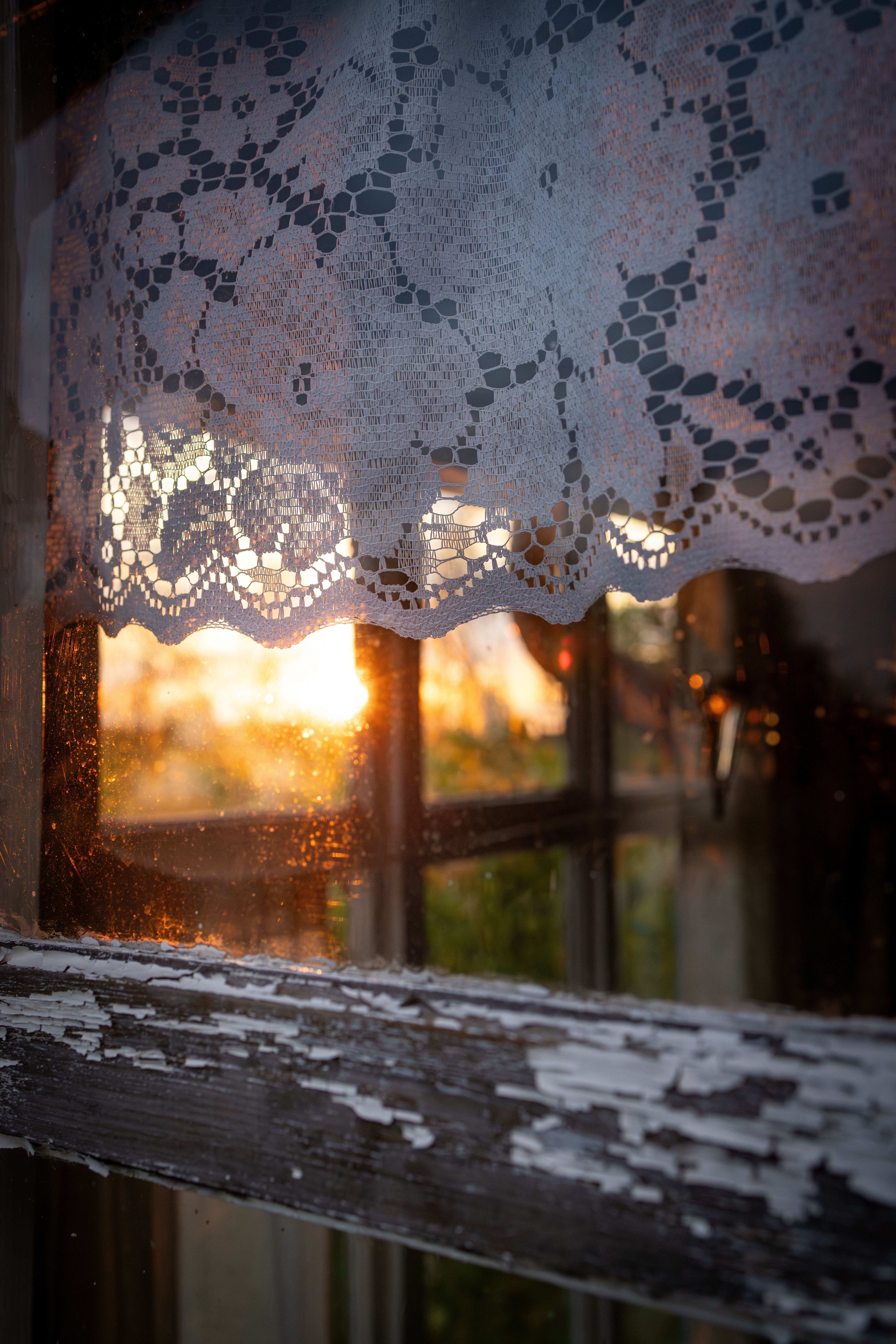
Excellent short story! But what caught my eye is those are the exact same curtains I have in my kitchen right now and they are curtains my mother bought probably 35 years ago, but I like them so much!